FLEDA DIGITAL TWIN PLATFORM
Complement System Digital Twin
A knowledge twin and rule-based simulation sandbox for exploring complement pathways, disease contexts, biomarkers, and drug target interventions.
0
Seed entities
0
Mechanistic relationships
V1
Knowledge Twin + Rule-Based Simulation
Organ Impact Twin
Systemic impact of complement activation
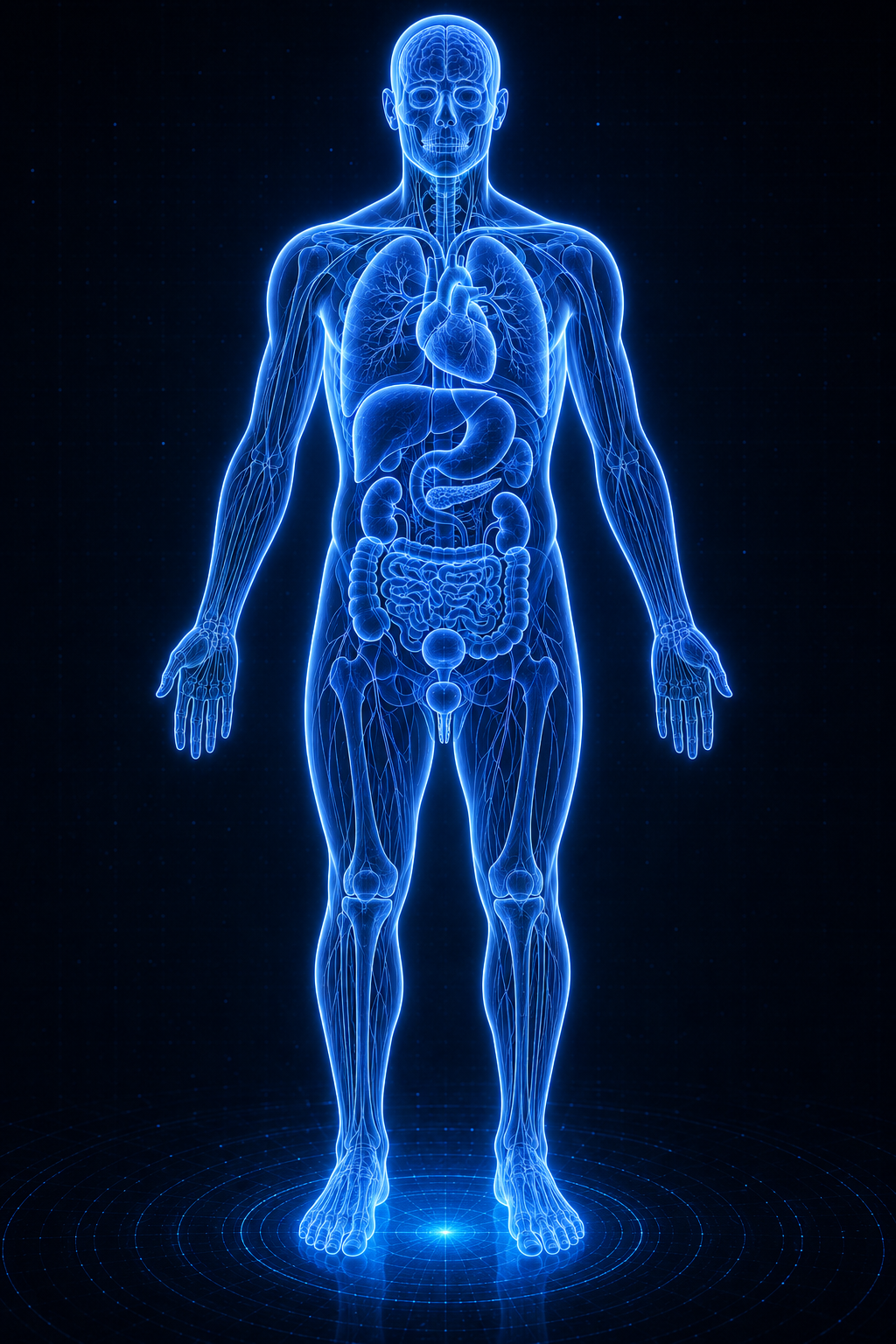
♥72BPM
BP120/80mmHg
RR16/min
Current systemic interpretation
0 min
Selected Organ Structure
Normal vs. complement impact-state tissue model
Select an organ marker or impact card
AI-generated, literature-informed tissue model for research and education. It is not a diagnostic histology image, patient biopsy, or patient-specific finding.
AMD Disease Context Module
Age-related Macular Degeneration Digital Twin View
AMD is modeled as a retina-centered complement-mediated chronic disease state over months, not an acute 120-minute reaction. Systemic cards represent association or pathway relevance, not deterministic organ damage, and AMD does not drive heart-rate changes in this model.
Complement Mechanism
Secondary Association Layer
Systemic Plasma Biomarkers
Cohort-relative markers from EDTA plasma. These do not represent retinal tissue concentrations.
Local Ocular Complement Activity
Aqueous, vitreous, or ocular-tissue signals are kept separate from circulating biomarkers.
Retinal Disease-State Proxies
Imaging or tissue-risk proxies; not blood concentrations and not a diagnosis.
Literature Calibration Layer
Curated Evidence Records
Candidate Calibration Suggestions
These are reviewable hypotheses from curated seeds or local public literature terms. They do not change the formal model.
Candidate conflict review is pending.
Drug Target Simulation Interpretation
Simulation time: 0 min
Conversational Experiment Workspace
Describe the complement experiment you want to explore
Use disease, complement component, time scale, experimental condition, and intervention details. The system prepares a transparent plan before changing the simulation.
Simulation result
Describe an experiment, review the prepared plan, then run it in the main dynamics and organ-impact display above.
Research and education use only. Do not enter patient identifiers, medical records, clinical case details, treatment decisions, or production data. Prepared plans remain in this browser session and are not uploaded.
Private Model Research Model Training Record View record
Optional Research Workspace Advanced Research Tools Expand literature intelligence, biomarkers, pathway maps, validation, knowledge graph, and low-level simulation controls. Expand tools
Model Maturity & V2 Roadmap
From transparent prototype to calibrated research platform
AMD uses curated literature-derived priors, disease-specific organ mapping, and retina-centered chronic progression logic.
The engine is transparent and explainable, but not yet calibrated with real biomarker cohorts or experimental datasets.
Outputs are hypothesis-support signals and risk proxies, not diagnosis, patient prediction, or regulated medical software.
Model Change Ledger
Traceable releases and controlled changes
Candidate suggestions never replace the active model. Every public record exposes its evidence level, validation result, limitations, policy route, and rollback version.
Scientific comments become available with the independent Fleda Research Workspace.
AMD, PNH, aHUS, and sepsis use different tissue-weight logic so one complement pattern does not imply the same biology everywhere.
Structured evidence records produce parameter priors for disease context, pathway activity, and tissue sensitivity.
Add C3, C4, CH50, AH50, C3a, C5a, sC5b-9, Factor H, Factor I, Factor B, and Factor D to initialize scenarios.
Compare no intervention, C3 inhibition, C5 inhibition, Factor B/D inhibition, and regulation enhancement side by side.
Generate a research report with inputs, assumptions, curves, disease-specific proxy scores, evidence priors, and disclaimer.
Compare anonymized aggregate observations with model proxies; future work will add PMID-linked extraction records, laboratory datasets, imaging features, and experimental validation.
Data Needed To Upgrade Model Maturity
Complement biomarkers: C3, C4, CH50, AH50, C3a, C5a, sC5b-9
Regulators and factors: Factor H, Factor I, Factor B, Factor D, CD55, CD59
AMD-specific data: OCT, drusen burden, geographic atrophy, CNV status, RPE stress markers
Evidence metadata: PMID, cohort size, sample type, assay method, disease stage, intervention status
V2 Prototype Feature Biomarker-Guided Initialization Enter observed or hypothetical complement biomarkers to estimate pathway activity before running Live Dynamics.
This panel is a research initialization aid. It converts biomarker patterns into transparent model priors and does not diagnose disease or predict patient outcomes.
V2 Prototype Feature Drug Comparison Mode Compare transparent pathway proxy outputs across candidate interventions.
Comparison values are qualitative research proxies from the active rule model, not efficacy, safety, or treatment recommendations.
V2 Prototype Feature Validation Dataset Compare one anonymized aggregate observation against the active rule-model proxy.
Use only anonymized aggregate or public observations. This tool does not accept clinical case details and never uploads the dataset.
Literature Intelligence V1
Evidence integration foundation
Local infrastructure for traceable literature evidence, independent AI cross-validation, and controlled model calibration.
Applied Literature Catalog
Published evidence used to guide candidate model calibration
Ranking favors recent publications, stronger evidence designs, recognized sources, and relevance to the selected mechanism. Work from Dr. John D. Lambris and collaborators receives a visible expert-source bonus, never a substitute for evidence quality.
Parameter calibration readiness
Assessing structured evidence...
Controlled learning boundary
Public literature can generate evidence records and candidate calibration guidance. It cannot automatically overwrite the active model. Promotion requires source verification, unit and context checks, conflict review, validation, and a new versioned release.
Local service
Checking...
Evidence database
Checking...
Monthly AI budget
$0.00 / $50.00
Data boundary
Standalone Fleda
No GN connections
Saved public PubMed records
Public protein annotations · UniProtKB
Public pathway annotations · Reactome
Unified public knowledge layer
Records remain separated by source layer and record type. This view is for traceability and review; it does not change formal model parameters.
Provide anonymous research feedback
This form creates a local JSON file only. Do not include patient identifiers, clinical case details, or production data.
Complement Pathway Map
Integrated classical, lectin, alternative, terminal, and regulatory flow
Classical Pathway
Immune complex -> C1q/C1r/C1s -> C4/C2 -> C4b2a
Lectin Pathway
MBL/Ficolin -> MASP-1/2 -> C4/C2 -> C4b2a
Alternative Pathway
C3 tick-over -> C3(H2O) -> Factor B/D -> C3bBb
C3 Cleavage
C5 Cleavage
C5b-9 / MAC
Terminal Pathway
C5a inflammatory signal + C5b/C6/C7/C8/C9 MAC formation
Regulatory System
Factor H, Factor I, CD55/DAF, MCP/CD46, CD59
Disease Contexts
PNH, aHUS, C3G, AMD, lupus nephritis, sepsis and more
Advanced Research Mode Advanced Dynamics Explorer Optional low-level parameter console for researchers who need direct control over concentrations, pathway activity, time step, and intervention timing.
Event Timeline
Current Time Inspector
Biological Interpretation
Knowledge Graph Explorer
Click an entity to inspect relationships, evidence, diseases, and drug targets
Simulation Console
Rule-based V1 simulation for pathway activity and drug intervention logic
AI-style Summary
Model versionLoading...
Evidence basisSeed knowledge graph
UncertaintyQualitative proxy
Result sourceJavaScript fallback
Disease Context Panel
Mechanisms, biomarkers, targets, and modeling notes
Drug Target Intervention Panel
Compare upstream and downstream consequences of complement inhibition
Literature Evidence System